Choose one comparison boundary
Start by deciding what you are trying to measure. You might compare provider offers for the same deposit, or compare how much of an existing wallet balance becomes usable at a destination. Those are related questions, but they are not identical. An offer ranking can omit the cost your own wallet incurs to reach the provider.
Write the boundary plainly: for example, how much USDC on Ethereum can I use after spending this amount of BTC from my wallet? That question identifies the source, destination and total budget. It prevents a quote for another chain or a different deposit amount from being compared as if it solved the same problem.
Separate four cost locations
The outgoing wallet or exchange may charge to send the deposit. The provider offer determines the expected receive amount under its terms and can reflect provider and payout economics. The destination service may have crediting or withdrawal rules. A later self-custody transfer can require its own network fee. Review each location using its current screen.
Do not assume every route lists each component as a standalone fee. If the provider’s expected receive amount already accounts for a cost, subtracting an estimated version again would distort the comparison. Conversely, a generous receive figure does not mean your sending exchange will waive its withdrawal fee. The useful distinction is who charges and where the result is reflected.
| Cost location | Where to inspect it |
|---|---|
| Getting funds to provider | Sending wallet transfer estimate or exchange withdrawal preview |
| Provider exchange and payout | Current offer, rate conditions and stated provider costs |
| Destination account | Receiving platform deposit and withdrawal rules |
| Later transfer | Receiving wallet fee preview on its actual network |
Make provider offers comparable
Choose the same source asset, source network, destination asset, destination network and amount before comparing providers. Use current offers from the same route search. A quote for USDC on a network your exchange does not accept is not a useful saving, even if its numerical output is larger.
Compare rate modes deliberately. Floating and fixed conditions are different commitments, and a fixed offer can depend on paying correctly within its window. Provider verification, refund handling and available limits may also affect whether an offer is suitable. Price is one decision input; it is not a substitute for conditions you can actually meet.
Compare fixed and floating ratesA hypothetical comparison with a withdrawal deduction
Suppose an exchange charges an illustrative 2 USDT to withdraw, and its preview says a gross 502 USDT request delivers 500 USDT. Two provider offers for that 500 deposit show 497 and 496 USDC on the same destination chain. These numbers explain the method; they are not current quotes or platform fees.
The user compares 497 versus 496 USDC for the same actual 500 deposit, then recognizes that the total source expenditure is 502 USDT. If the user instead enters a gross 500 withdrawal that delivers 498, neither 500-deposit offer is being followed correctly. The calculation should be corrected before creating the order or requesting a different amount-specific offer.
Avoid percentage comparisons that hide fixed costs
For small deposits, a fixed sending charge can represent a larger share of the budget than it does for larger deposits. That arithmetic does not mean a larger swap is automatically appropriate. Compare only amounts you intend to exchange and can deliver within the provider limits, and retain enough balance for the outgoing transaction.
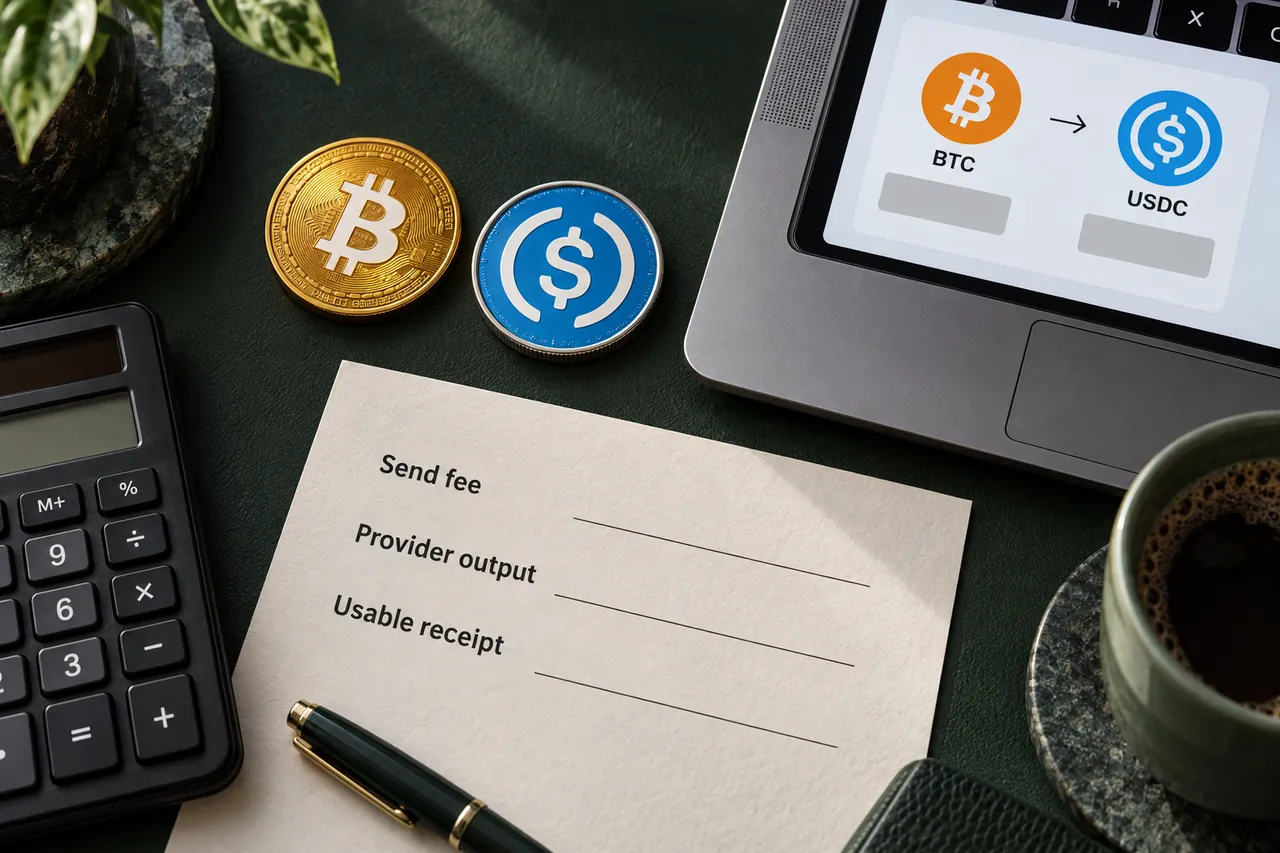
A simple diagnostic is to write total source spent beside usable destination received. If converting the result into a common currency, use a contemporaneous reference and recognize that market values can change. Do not present a calculation built from stale prices as a live effective rate, and do not assume stablecoin units are risk-free cash equivalents.
Consider the next move without inventing a fee today
If your purpose is to transfer the payout again, inspect the requirements of that next action. Receiving USDC in self-custody may leave you needing the destination chain’s native fee asset. An exchange may apply its own withdrawal minimum and charge. Those future conditions can change, so a guide’s fixed figure is not a reliable budget.
Keep later-use planning distinct from the current provider obligation. The provider is expected to deliver the order’s asset to its recipient under the selected terms; it does not automatically pay every future transaction you make. Record which costs belong to the present order and which arise only if you choose the next action.
Check USDT network and sending costsRecord enough detail to check the outcome
Before depositing, save the selected offer, amount, networks and provider conditions. After sending, retain the actual deposited amount and transaction hash. At completion, compare the payout with the terms and the receiving wallet evidence. A rate question is easier to investigate with the original conditions than with a memory of the approximate homepage estimate.
- Define the exact source and usable destination balance.
- Check the amount the sending wallet or exchange will deliver.
- Compare live provider offers for identical route inputs.
- Identify which charges are already reflected in the receive amount.
- Check any destination or later-transfer requirement before choosing the route.
A FEW MORE DETAILS
Common questions
Is the provider with the largest output always best?
The largest usable output is useful only if its network, limits and conditions meet your needs. Review provider terms, deadline and any verification process alongside the amount.
Should I subtract a network fee from every quote?
No. Check where each fee is charged and whether it is already reflected. A separate wallet fee and a cost already included in provider output should not be counted as the same charge twice.
Why are small swaps sometimes relatively expensive?
A fixed sending or processing cost can be a larger fraction of a small amount. Compare the actual route and current fees rather than assuming one percentage applies at every size.
Can I calculate the final cost before sending?
You can estimate using current offers and wallet previews, but changing rates, network conditions and provider terms can affect the result. Preserve the confirmed conditions rather than treating an old estimate as final.
Prepared by Tornado Swap to explain the swap workflow. Network conditions and provider offers can change; check the current order instructions before sending funds.