The ticker identifies an asset, not an abbreviation preference
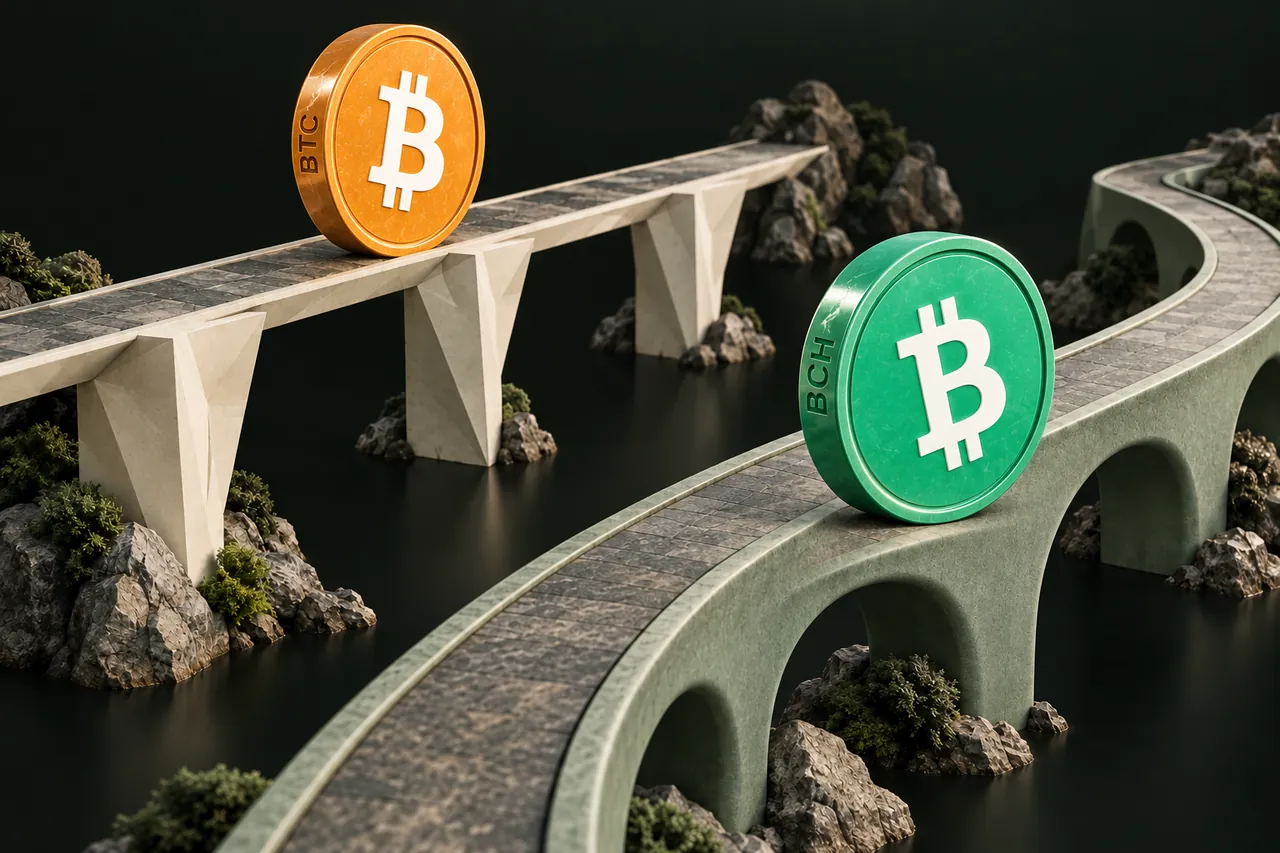
BTC and BCH refer to different coins. A wallet or exchange may group them in a list or use related visual branding, but each maintains its own balances and transaction history. Selecting the wrong one can send a real payment that does not match the provider's order.
Read the full source line before entering an amount. If you hold BCH and want BTC, choose a BCH-to-BTC route rather than selecting BTC and paying from a BCH wallet. A conversion requires an actual supported route; it is not accomplished by omitting a network prefix or changing how the coin name appears.
Address appearance is not enough to prove compatibility
Some historical address formats can look similar across related networks. Bitcoin Cash also uses formats intended to make chain context clearer. That history is a reason to check the network carefully, not a reason to assume any technically recognizable address is safe for both assets.
Use the current address supplied for the exact asset by the provider or receiving service. Do not manually remove prefixes, convert formats using an unverified website or reuse another chain's old address to get past a wallet warning. An accepted address format only establishes one syntactic property; it does not establish the service's deposit policy.
How to choose the receiving networkA QR cannot convert BTC into BCH
A scanner reads encoded data. Tornado Swap's provider QR contains the deposit address only, without a network or amount instruction. If the paying wallet is on the wrong chain, successfully reading the address does not prove the transaction will satisfy the order.
After scanning, compare the text with the order, select the correct source coin and enter the exact amount. If the wallet warns that the address is incompatible, investigate the source network and current order rather than suppressing the warning. A format conversion cannot change the blockchain balance you actually spend.
Wrapped Bitcoin is another separate question
A token that represents BTC on an EVM chain is not a native Bitcoin deposit. Likewise, a BCH-related token on another network is not automatically BCH mainnet. The presence of Bitcoin in an asset name does not make every representation accepted by a provider's native-coin address.
Check which asset you actually hold in the sending account. A portfolio page can combine values from several networks, obscuring that the desired native balance is unavailable. If a representation is not listed as a source option, do not use it to fund another source entry. Ask about support or choose a genuinely supported holding.
Worked example: deliberately converting BCH to BTC
Imagine a user has an illustrative 0.5 BCH and wants BTC in a Bitcoin wallet. They obtain a current Bitcoin receiving address, select BCH mainnet as the source and BTC mainnet as the destination, and request current provider routes. No fixed BTC output is assumed from the names.
They compare the estimated receive amount, rate type and handling information, then review the recipient and summary at wallet details. After creation, they fund the generated deposit with BCH on Bitcoin Cash. The provider later arranges the Bitcoin payout. The two legs can have separate transaction IDs on their respective networks.
Fees and confirmation policies must be read per leg
A BTC network fee estimate is not a BCH fee estimate, and an exchange's withdrawal charge is another number again. Check the sending wallet or service's actual cost and net amount. If a fee is subtracted from the entered deposit, the provider may receive less than the confirmed order expects.
Provider confirmation requirements can also differ from a wallet's simple success label. A source transfer confirmed on Bitcoin Cash does not prove a Bitcoin payout has occurred. Follow the order's actual progress and any supplied payout record rather than assuming both networks share timing because the names or wallet screens look related.
If the wrong chain was used, preserve the facts
Do not try another payment immediately. Save the swap ID, actual source coin and network, destination address, amount and transaction ID. State which order was intended and what was actually sent. That gives support a concrete mismatch to investigate.
Recovery depends on technical control and provider or receiving-service policy; it is not guaranteed by shared address ancestry. Never provide a seed phrase or private key to someone offering to recover a wrong-chain deposit. A new order cannot retroactively change which network a confirmed transaction used, and deleting a browser page does not cancel the payment.
Use a two-name final check
Before signing, read both the asset and network aloud or compare them line by line with the order. In this particular case, BTC versus BCH is not a minor spelling difference. Keep the destination wallet and optional source refund address labeled so each role remains clear.
The table summarizes what each label permits you to infer. A listed pair still needs a usable live provider quote for the exact amount, and possible provider verification requirements remain separate from blockchain compatibility. If no route is returned, do not fund an unrelated order hoping that a similarly named coin will be accepted.
| Label or evidence | What it establishes |
|---|---|
| BTC mainnet | Bitcoin source or destination asset |
| BCH mainnet | Bitcoin Cash source or destination asset |
| Address accepted by wallet | Format compatibility only, not service credit |
| Confirmed source transaction | Payment on that source chain, not destination payout |
A FEW MORE DETAILS
Common questions
Can I fund a BTC order using BCH?
No. Use the asset and network in the order. To convert BCH to BTC, request that explicit source and destination route.
Does a similar address mean both networks work?
No. Similar formatting or shared history does not establish provider support or custodial account credit.
Is wrapped BTC the same as native BTC for deposits?
Not automatically. A token representation on another chain is a different source identity from Bitcoin mainnet.
Can support always recover a wrong-chain transfer?
No. Recovery depends on technical control and the relevant service's policy. Preserve evidence and contact official support before any further payment.
Prepared by Tornado Swap to explain the swap workflow. Network conditions and provider offers can change; check the current order instructions before sending funds.