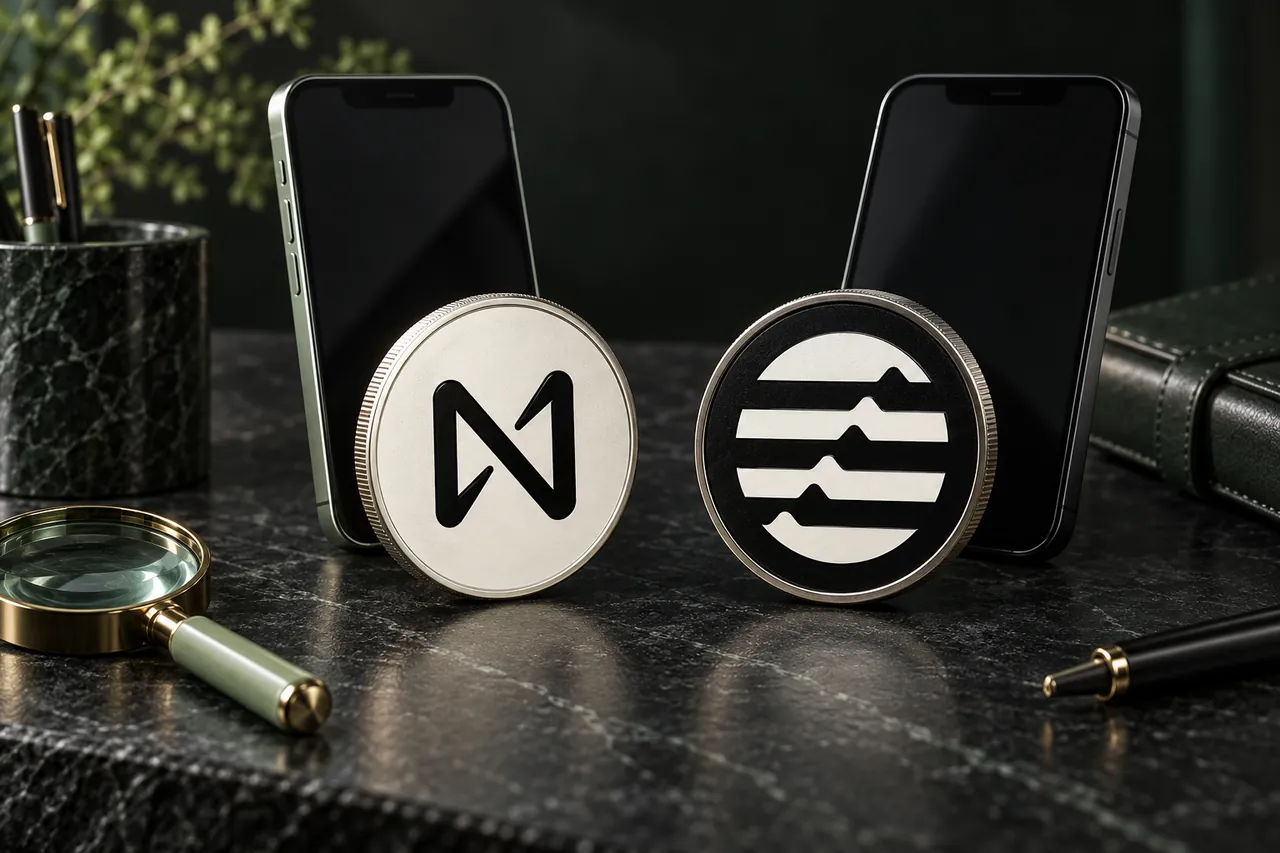
NEAR account names need their own context
NEAR supports account conventions that can include human-readable account names as well as implicit forms. A readable name is still a network account identifier with specific control, not an email address or a universal crypto username. Do not assume another chain or provider resolves it automatically.
Use the current receiving instructions from the wallet or service and verify what the provider form accepts. If it requests a different supported representation, obtain it through the wallet's legitimate receive process. Do not invent a name variant, remove a suffix or substitute an unrelated public key to make validation pass.
How to choose the receiving networkAptos addresses are not EVM addresses by appearance
Aptos accounts use their own address system, commonly shown as 32-byte hexadecimal identifiers. A string starting with 0x is not enough to identify Ethereum, BNB Smart Chain, Sui or Aptos. The chain and account context must accompany the address.
Copy the Aptos recipient exactly from the destination and confirm the selected provider supports it. Do not shorten, pad or otherwise normalize it by hand because another tool displays a different form. Account standards and application handling can evolve; the actual wallet and provider acceptance are more useful than a prefix-only rule from a generic tutorial.
Native assets and bridged tokens are separate
The curated entries are NEAR mainnet and APT mainnet. A bridged NEAR token on another chain is not automatically accepted as native NEAR, and an APT-related representation is not automatically native Aptos. Inspect where the source balance actually lives.
For a source exchange, check the exact withdrawal network and net amount. For self custody, review the wallet's native send preview. If the intended representation is not listed, do not fund a different source entry with it. A provider's ability to deliver one native asset does not imply it accepts every wrapped version bearing the same ticker.
Fees and available balance still need review
Ordinary transactions need a valid fee-paying arrangement on their own network. NEAR and Aptos have their own native fee context, and a wallet's current preview is the place to see what the intended transfer requires. A token portfolio value does not establish a usable fee balance.
Some applications can offer sponsored features or abstract parts of account handling, but those features are specific to the actual wallet and action. Do not assume every incoming payment requires a prefunded account, or that every future outgoing operation will be free. Check the operation you need rather than applying another chain's gas or reserve rule.
Worked example: NEAR to APT as a deliberate route
Imagine a user holds an illustrative 20 native NEAR and wants native APT in an Aptos wallet. They obtain the Aptos receiving address, select NEAR mainnet as source and APT mainnet as destination, and request a current usable provider quote.
The user verifies the recipient and summary at wallet details and confirms the order. If the form requests an extra ID, they follow the destination's actual memo instructions and use an explicit no-memo value only where the form tells them to; this is not a claim that every Aptos account requires a memo. Their source payment uses NEAR and the provider's current deposit instructions. The Aptos address is only for payout; sending NEAR directly to it outside the created route does not perform a conversion. No numerical APT output or timing promise follows from this example.
Check each identifier in its actual role
The provider deposit address, recipient, optional refund address and swap ID are different fields. A readable NEAR account name in one field should not be copied into the Aptos recipient merely because it is easier to remember. Label the roles in any private notes you keep.
The QR contains only the deposit address and does not resolve this context for your phone. Check source network and amount separately, along with any additional instructions. Keep the swap ID and actual source transaction record. If a payout is shown, verify it on the destination chain with the recipient originally confirmed.
A final account-format checklist
The table helps avoid the temptation to identify a network from an address prefix or wallet brand alone. Ask whether the actual recipient can accept the native asset and whether the selected provider supports that representation. A route listing still needs a usable quote for your amount and filter.
If validation or a payout display is unclear, contact support before sending again. Describe the source and destination chains explicitly and preserve the order ID. A new order cannot repair a confirmed wrong-network transfer, and account-name convenience does not remove provider policies, possible verification or the receiving service's credit rules.
| Question | Check |
|---|---|
| Wallet view | Correct asset and network receiving screen |
| NEAR account | Current supported named or implicit form |
| Aptos account | Actual Aptos address, not a guessed 0x chain |
| Native source | Not a wrapped representation from another network |
A FEW MORE DETAILS
Common questions
Can one multichain wallet address receive NEAR and APT?
Do not assume so. Open each network's actual receiving screen and use the supported destination for that asset.
Does a 0x prefix prove the address is Ethereum?
No. Multiple ecosystems use hexadecimal-looking addresses. Verify the chain and complete account context.
Can I enter a NEAR name into any provider field?
Only when the actual provider and form support that account representation. Do not modify names to bypass validation.
Does sending NEAR directly to an Aptos address convert it?
No. A cross-network conversion needs an explicit supported route with separate source deposit and destination payout instructions.
Prepared by Tornado Swap to explain the swap workflow. Network conditions and provider offers can change; check the current order instructions before sending funds.